How AI Became Real Estate's Invisible Gatekeeper — And Why the Window to Act Is Already Closing
The Conversation That Never Happened
Somewhere in America right now, a prospective homebuyer is having a conversation that almost no real estate professional will ever know took place.
It starts with a simple question:
“Who is the best realtor in my area?”
A few seconds later, an answer appears. Not a page of links. Not twenty competing profiles. Not a directory disguised as research. Just a recommendation — one name, perhaps two — with a short explanation that sounds calm, informed, and oddly final.
A decade ago, that sort of answer would have felt premature. Today, for many buyers, it is the beginning of real diligence rather than the end of it.
The buyer keeps going:
“Which of those brokers has the strongest reputation helping foreign buyers purchase luxury condominiums?”
“Who has recently represented buyers above $5 million?”
“Who has access to off-market inventory?”
“Which of them is most familiar with pre-war co-op board approvals?”
Each follow-up strips away a little more noise.
Each answer makes a few names feel safer, more credible, more obviously right.
By the time the buyer reaches for a phone, the decision has often been shaped already.
Not on Zillow.
Not on Google.
Not on social media.
Inside an AI conversation.
That is what makes this moment different. AI search is not simply a faster version of traditional search. It is a compounding system. A buyer asks one question, then another, then a more specific one after that. The answer engine keeps narrowing the field until the recommendation begins to feel less like a suggestion and more like a conclusion.
To the buyer, it feels objective.
To everyone excluded from the exchange, it is invisible.
Every realtor whose name never enters that conversation will never know the buyer existed.
No lead was lost.
Because no lead was ever created.
The Number That Defines This Moment
Real estate is the largest asset class in the American economy. Yet according to The 2026 Luxury Real Estate AI Discovery Report, jointly published by Haute Real Estate Network and 5W Public Relations, the sector ranks last among major U.S. verticals in Google AI Overview visibility, with a reported trigger rate of 0.14%.
The same report places health at 13%, finance at 4.2%, and retail at 2.1%.
That would be striking enough on its own. What makes it more revealing is the contrast inside the profession itself. The report also says that 82% of agents use AI in their daily work.
In other words, the industry has embraced AI as an operating tool far faster than it has adapted to AI as a discovery system.
That distinction matters now because the broader search environment has shifted again. In May 2026, Google described Search as entering “a new era for AI Search,” while outside observers summarized the same change more bluntly: search was becoming less a list of links and more a conversational interface.
For real estate, that creates an uncomfortable reality. The business has learned to use AI to work faster, but it has not yet learned how to be legible inside the systems buyers increasingly use to decide whom to trust.
How Discovery Quietly Changed
Every generation of real estate professionals has had to adapt to a different gatekeeper.
At first, the gatekeeper was information itself. For decades, access to listings was constrained by broker-held data and cooperative inventory systems. If a buyer wanted clarity, they needed a practitioner.
Then came the internet. Zillow and the portal era changed the center of gravity. Discovery became more public, and digital marketing became the new competitive edge.
Now the gatekeeper has shifted again.
Florida Realtors put it plainly earlier this year: as customers increasingly use AI to ask full questions, the professionals who structure content around clear answers may stand out and win more business online.
That is a subtle but important change. Buyers are no longer just searching for professionals. They are asking AI systems to interpret the market for them.
The difference sounds small until you see what it does to behavior.
Instead of comparing ten websites, a buyer may start with one synthesized answer. Instead of browsing broadly, they ask follow-up questions until they feel satisfied. The discovery layer does not just shorten. It starts thinking on the buyer's behalf.
The Collapse of Traditional Marketing
This is one reason the old marketing stack is showing strain.
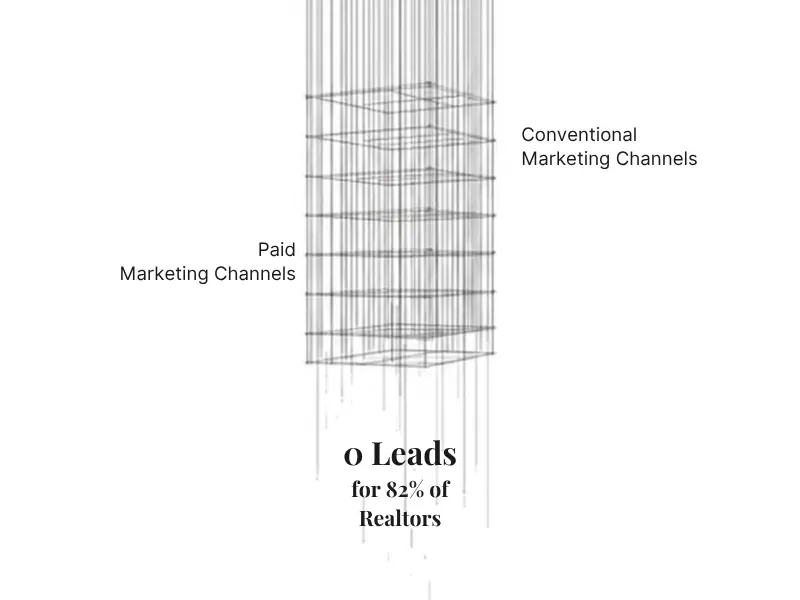
According to the 2026 State of Real Estate Marketing Report cited by Yahoo Finance, thirteen of the twenty-one marketing channels used by working real estate agents deliver zero leads to more than 70% of the agents using them. Across paid digital and portal channels, the average zero-lead rate is 82%.
Those numbers are less surprising when viewed through the logic of AI-mediated discovery. Buyers do not need to click the way they once did.
HousingWire's June 2026 analysis argued that the new real estate playbook is about getting cited by AI, not clicked on.
That is not rhetoric. It reflects measurable behavioral change. HousingWire reported that 68% of U.S. Google searches ended without a click in early 2026, rising to 83% when an AI Overview was present and 93% inside Google's dedicated AI Mode.
For years, digital marketing in real estate has been engineered around traffic acquisition. But if the recommendation itself now does most of the persuasive work, traffic is no longer the clean proxy for influence that it used to be.
The New Arithmetic
Standard MLS Listing
Optimized for Answer Engines with AIND™ Protocol

Traditional search engines present options.
AI synthesizes.
That difference changes the economics of visibility.
A conventional search can display dozens of names. An answer engine usually compresses that field into one recommendation or a very short shortlist. The practical result is harsh: every recommendation excludes a much larger group of plausible alternatives.
Visibility is no longer only a ranking problem.
It is becoming an inclusion problem.
41,554 Territories
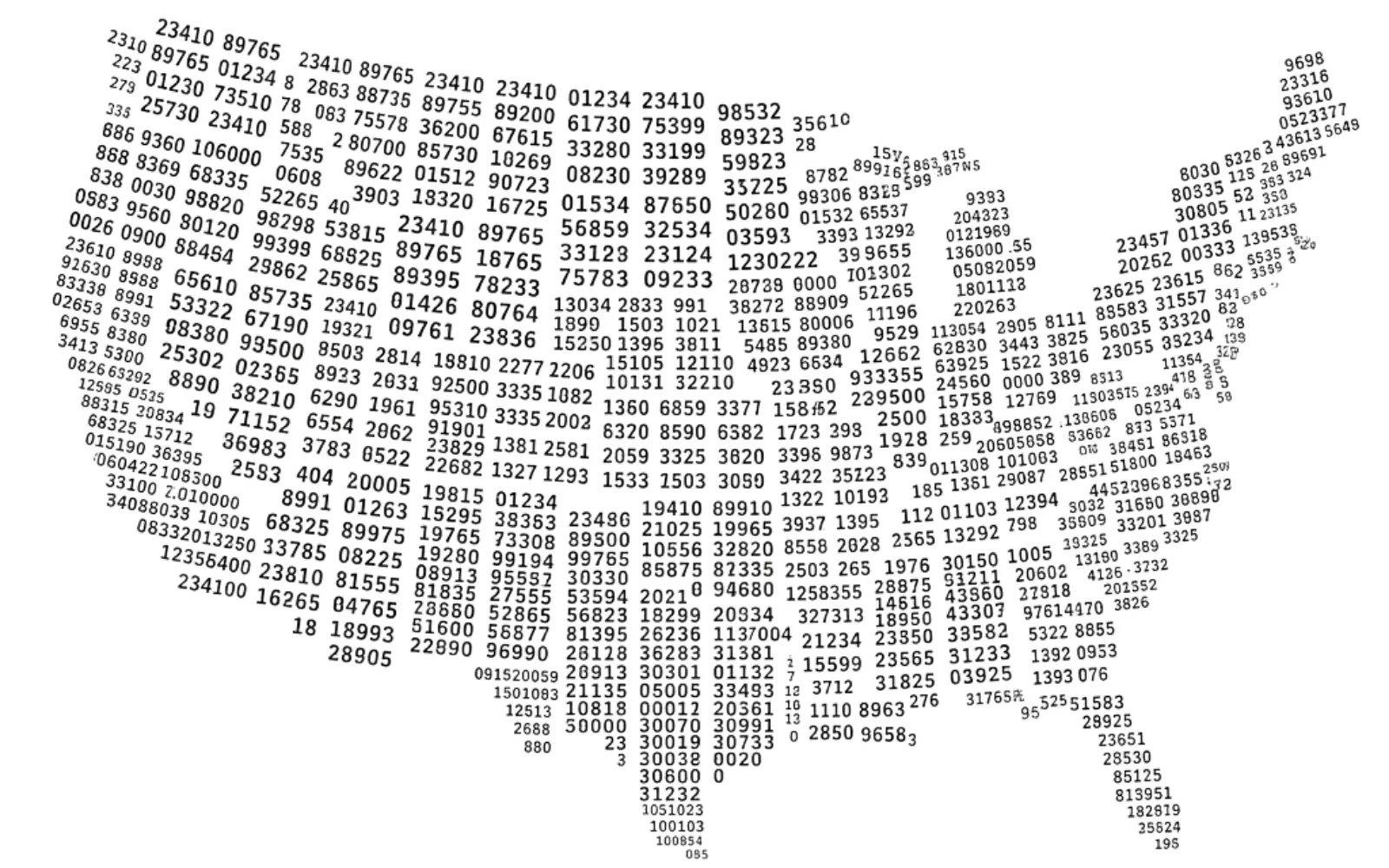
According to the United States Postal Service, there are 41,554 ZIP Codes in the United States.
Set beside that number, the profession begins to look crowded in a new way. The Haute Living report frames the market as roughly 1.5 million active NAR members and around two million licensed practitioners competing for discoverability in a country where recommendation happens locally, not nationally.
Every day, buyers ask questions tied to territory:
“Who is the best realtor in 90210?”
“Who specializes in Surfside waterfront homes?”
“Which broker understands Palm Beach ultra-luxury transactions?”
Those are not broad awareness queries. They are local trust queries.
And that matters because AI recommendation is not distributed evenly. In local markets, small differences in citation quality, entity consistency, and public proof can accumulate quickly. A practitioner who becomes the obvious answer in one geography may stay the obvious answer longer than the market expects.
That is part of what makes local luxury real estate especially exposed here: the market is fragmented, the margins are large, and the buyer often begins with very specific intent.
Check your AI Visibility Score with buyers in your area >
Why Some Practitioners Consistently Appear
AI systems do not recommend people because they are charismatic. They do not reward personality the way a referral dinner might. They do not care how polished a personal bio sounds.
They look for patterns they can verify: consistent entity information, geographic alignment, editorial citations, structured data, third-party mentions, and visible evidence of topical expertise. HousingWire's June 2026 AEO analysis makes the same point in operational terms, arguing that complete and actively managed business data has become a tier-one feed into the AI ecosystem.
This is why trust has become more architectural than rhetorical.
A practitioner may have an excellent offline reputation and still be weak in AI search if that reputation lives in forms answer engines cannot easily interpret or confirm. Another practitioner with less traditional prestige may appear more often simply because the public signal layer is cleaner, more consistent, and easier to validate.
Fragmented information produces fragmented trust.
And in AI search, fragmented trust is expensive.
What the Platforms Are Actually Building
The major real estate platforms are not missing this shift.
Realtor.com launched RealAssist AI recently in June 2026, describing it as an AI-first home-search experience that guides buyers from their first question through closing while keeping the human agent relationship central to the transaction.
That launch matters for two reasons. First, it confirms that the platforms themselves now see conversation, not browsing, as the next interface. Second, it reinforces that portal AI and open-web AI are related but separate games.
A practitioner can perform well inside a portal's controlled ecosystem and still remain weak in open-web answer engines such as ChatGPT, Gemini, Claude, or Perplexity. The datasets, weighting systems, and retrieval pathways are not the same.
That difference is easy to miss if everything gets filed under the generic heading of “AI.” It should not be.
Trust Becomes the Product
The shift becomes even more visible at the luxury end of the market.
Haute Living's April 2026 report argues that international and high-net-worth buyers increasingly use AI during the earliest stages of market research, particularly when they are exploring geographies where they do not yet have a trusted local network.
Consider a principal at a Hong Kong family office researching Manhattan acquisitions. That buyer may spend thirty minutes asking increasingly precise questions — not just about listings, but about co-op approvals, cross-border complexity, tax exposure, off-market access, and the reliability of a local operator.
At that stage, the buyer is not comparing advertising. They are stress-testing credibility.
If AI cannot repeatedly verify a practitioner's expertise through trusted public signals, that practitioner is less likely to appear throughout the conversation. And if the practitioner disappears from the conversation, the relationship may never begin.
At luxury price points, trust is no longer established only in the first meeting.
Increasingly, it is established before the meeting ever happens.
Recommendation Territory

Search engines ranked websites.
Answer engines increasingly recommend people.
Those are different competitive environments.
Within AIND's framing, Recommendation Territory describes the geographic market within which a practitioner has established enough trust signals to be consistently recommended across major answer engines.
That is not a formal industry standard. It is a practical way of naming a shift that many practitioners are starting to feel but have not yet clearly defined.
Every professional already has a physical territory.
The more pressing question now is whether they also control the digital recommendation territory around it.
The Window Is Already Open
Haute Living's April 2026 report describes the current period as a 24-month window before competitive density in AI discovery rises materially.
No forecast like that should be treated as scripture. Markets move unevenly, and some ZIP codes will mature faster than others.
Still, the direction is hard to ignore. Google is rebuilding Search around AI interaction. Realtor.com has launched a conversational home-search assistant. HousingWire is already telling the industry that the objective is citation, not clicks. Florida Realtors is telling practitioners to publish clearer answers because buyers are now asking full questions in AI systems.
Taken together, those developments point to the same conclusion: the discovery layer has changed, and the professionals who adapt early will probably have a longer runway than the market currently assumes.
For the first time, buyers can complete meaningful due diligence before visiting a single website.
That behavior is not a fad.
It is a structural change in how trust begins.
Visibility is no longer defined solely by where a website ranks.
Increasingly, it is defined by whether answer engines recommend a professional's name when buyers ask questions about a market.